Package-level declarations
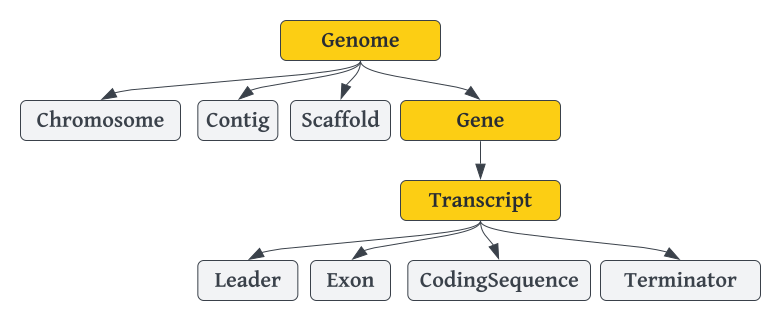
The featureTree package is used to represent the features of a GFF file as a tree, using the Parent attribute of the file to create parent/child relationships. To ensure that the parsed tree is meaningful, the package imposes limitations on the structure of the resulting tree, which is modelled after the standard structure used by genome databases, such as maizeGDB. The resulting tree must adhere to the parent/child relationships in this diagram: 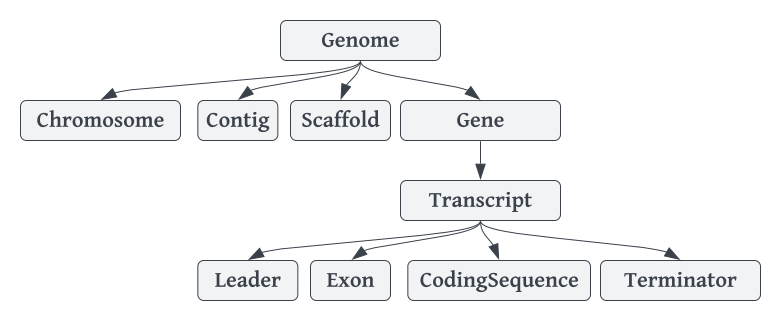 Note that the package generally avoids acronyms: 5' UTRs are referred to as leaders, 3' as terminators, and CDS as coding sequences. The tree structure allows for intuitive parsing up and down the tree. To avoid subtle errors, navigating to a different location in the tree generally requires "knowing where you are," that is, to find the Gene parent of a transcript, you must know that it is a transcript.
Parsing a GFF file to a tree requires only a single line:
val genome = Genome.fromFile("pathname.gff")GFFs that do not adhere to the structure will crash. Those that contain feature types that are not currently supported will have those features skipped but will otherwise parse normally. Parsing works irrespective of the ordering of the features in the file. The representation is totally immutable. Moreover, nodes may only be instantiated through GenomeBuilder, though it is recommended to only create trees from parsing GFF files.
Understanding the tree structure
Features
The class Feature contains the data of the nine columns of a GFF file, such as Feature.start, Feature.seqid, etc. The only member of the tree that is not a Feature is the Genome, which can be thought of as a container representing the entire file. 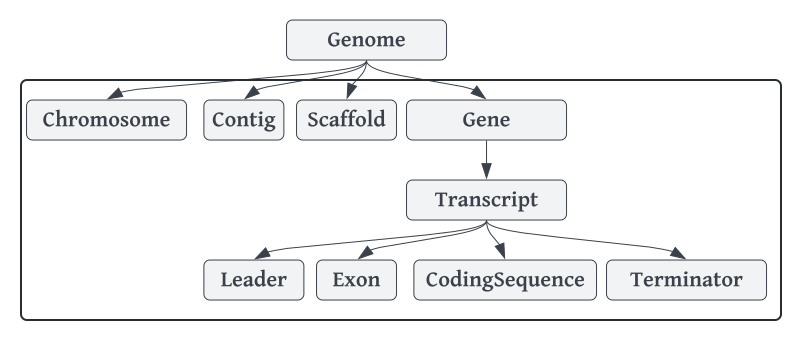
Child grouping
To ensure that the tree has the proper parent/child relationships, children are generally subtypes of a child group class, which supplies the pointer to their parent. For example, any direct child of the genome can call GenomeChild.genome to access the genome. Children can be accessed as instances of their child group through the children property of the parent, or as more specific instances through methods such as Genome.chromosomes, Transcript.exons, etc.
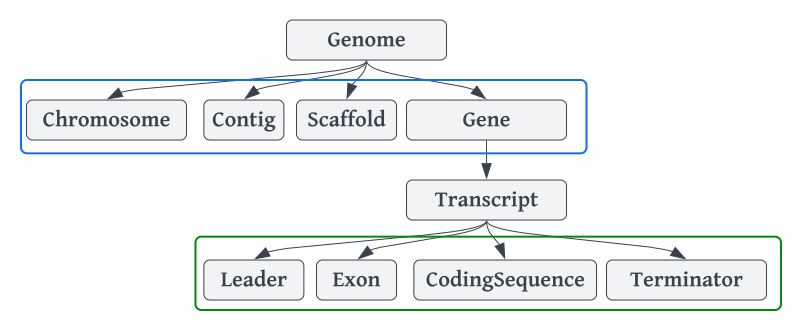
AssemblyUnits
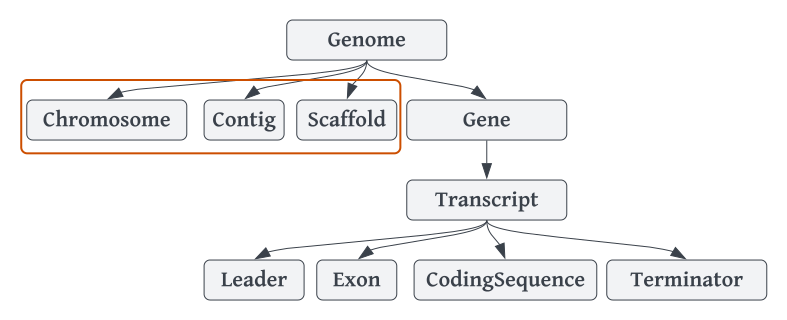
While Chromosome, Scaffold, and Contig do not list genes as their children, they do provide the AssemblyUnit.genes method, which can access the genes within the genome that have the same seqid as the AssemblyUnit.
Ancestors
All nodes on the tree that have descendants implement the Ancestor interface. This interface gives access to the Ancestor.flatten method, which collapses the tree representation into a list, allowing you to take advantage of the powerful Kotlin collections framework. A related method, Ancestor.within, will output a list of descendant features within a range of start and end points.
Types
A ParentResolver is a functional type that takes a String representing the child feature and a list of Features representing the potential parents and outputs the chosen parent
Defines ids, names, synonym, isA, and partOf relationships for types. Each genome will have a type schema, that may be modified from the base type schema defined by the sequence ontology to be more permissive.
Properties
Functions
Will use output of fallback if this throws an exception